

Dhaval Joshi Sees Not One AI Bubble But a Rolling Sequence Inflating and Popping Across Markets

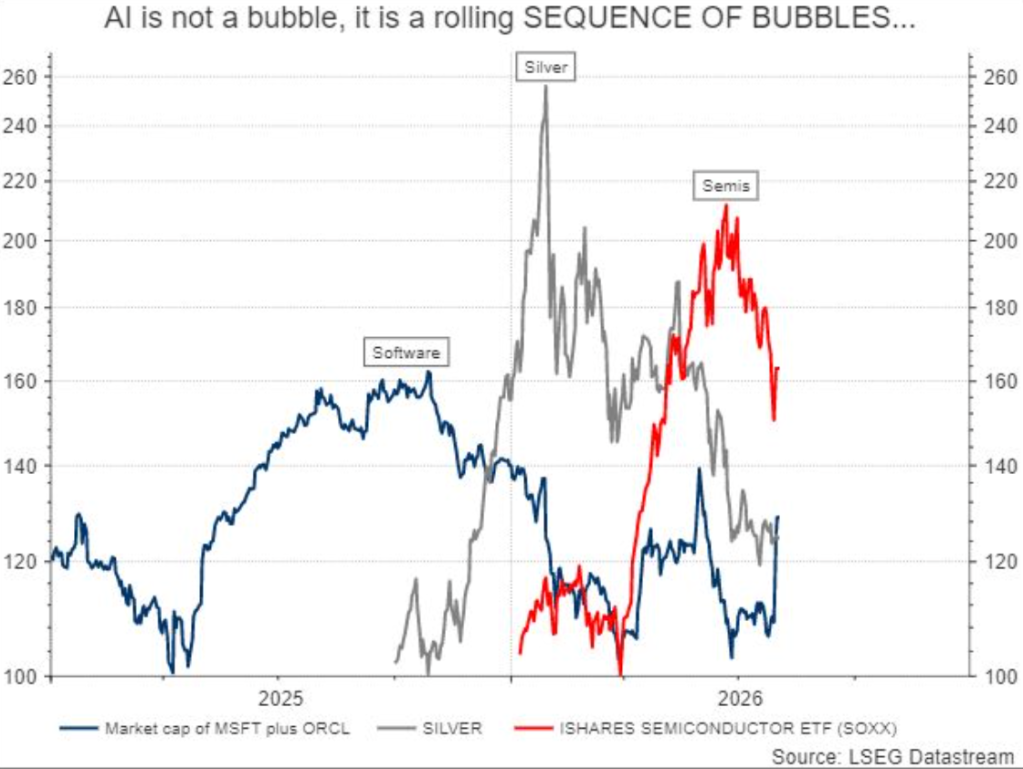
The conventional wisdom often posits a singular, monolithic bubble when discussing rapidly appreciating asset classes, particularly in emerging technological sectors like artificial intelligence. Yet, Dhaval Joshi, formerly a chief strategist for Counterpoint at BCA Research, presents a different, more nuanced perspective. He argues the market isn’t witnessing a single AI bubble inflating towards an eventual, dramatic burst, but rather a dynamic, rapid-fire sequence of smaller bubbles, each forming, expanding, and then deflating in succession. This pattern, he suggests, reflects investors’ ongoing struggle to pinpoint precisely where AI’s true value will ultimately reside.
Joshi’s analysis highlights how capital flows rapidly from one perceived AI beneficiary to another as initial investment theses prove unsustainable. This phenomenon, which he has termed a “rolling sequence of bubbles,” helps explain seemingly disparate market movements, from what some have dubbed the “SaaSpocalypse” in the software-as-a-service sector to significant volatility observed in silver and semiconductor stocks. He illustrates this by pointing to a brief but intense rally in software stocks, driven by the belief that AI would be a massive productivity enhancer. That enthusiasm quickly waned as investors began to grasp that AI agents might instead threaten the very subscription models central to SaaS companies, leading to a swift market correction for many.
The pattern extends beyond software. Silver, a metal critical for its electrical conductivity, saw its price surge on projections of soaring demand from power-hungry data centers. However, this spike proved ephemeral; a reassessment of its fundamental value relative to other conductors and the actual scale of demand could not justify such a near-trebling in price. Similarly, the semiconductor sector experienced a boom predicated on the idea of limitless pricing power for chipmakers. Joshi contends that this too is unwinding as investors realize that these firms, despite their current dominance, lack impenetrable “moats” around their profits. He predicts that the astronomical margins currently enjoyed by chipmakers will inevitably return to earth as supply and demand eventually find equilibrium.
What distinguishes these rapid inflations and deflations from typical market price discovery, according to Joshi, is their sheer amplitude and velocity. He notes that if one can make a fortune in a matter of weeks or months, only to lose it all just as quickly, it meets the criteria of a bubble. The market’s normal re-evaluation of winners and losers typically doesn’t involve such extreme swings in magnitude and rapidity. Instead, he suggests, a form of narrative contagion briefly takes hold, driving a speculative mania, before rolling off to the next perceived opportunity. This misallocation of capital isn’t confined to equity markets either, as the silver example clearly demonstrates.
For now, the cyclical nature of this reinflation has prevented a correlated market-wide selloff, offering a measure of stability. Yet, the underlying question remains: which investment, if any, will emerge as the next in this rolling sequence? While major figures from Jamie Dimon to Sam Altman have acknowledged the “bubbly” nature of current valuations, Joshi’s framework offers a mechanism to understand how the market continues to absorb these pressures without collapsing entirely. He suggests the peak of AI capital expenditure will likely occur in late 2026 or the first half of 2027, and that current outsized earnings are built on “stratospheric and unsustainable profit margins,” though he remains open to a different view if those margins normalize without impacting profitability.
The broader implications of this rolling sequence lead to a fundamental question about the distribution of AI’s value. Joshi outlines three potential outcomes: a continuation of the Web 2.0 model where a few corporations with strong moats capture the lion’s share; a scenario where “superstar individuals” leverage AI to reduce their costs while maintaining premium output; or, perhaps most intriguingly, a future of “massive competition” so intense that profit margins collapse, making the general consumer the ultimate winner through dramatically lower prices. This perspective suggests that what appears as a series of distinct market events might actually be a giant wall of capital relentlessly searching for sustainable returns, exhausting one perceived moat after another. He even points to an unexpected candidate for a recent micro-bubble: DDR3 RAM, a nearly obsolete memory chip, which surged 600% in less than a year. The discipline for investors, he advises, lies in keenly observing which narratives are inflating next, and which seemingly robust “moats” are, in fact, drying up.
Previous Post
Next Post


Sponsored Content

Sponsored Content