

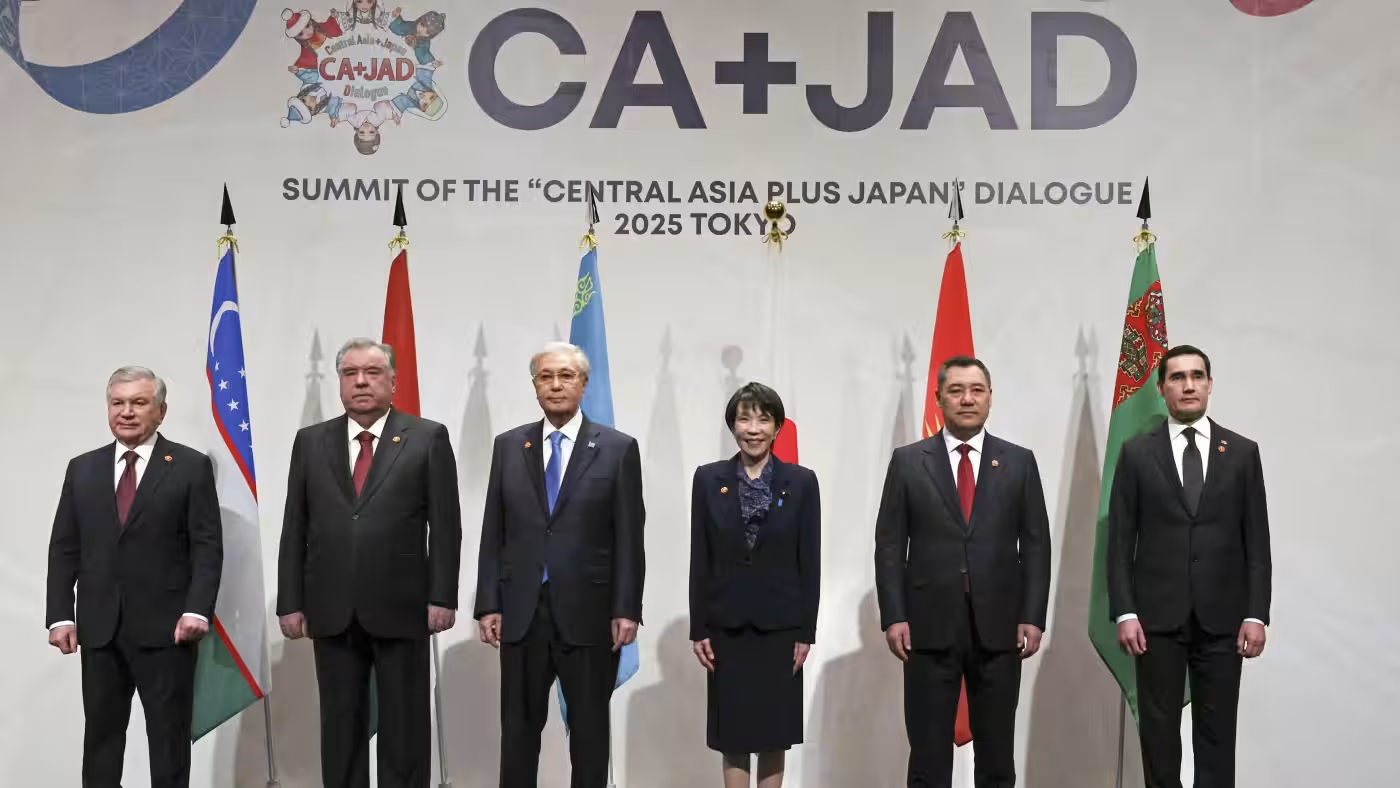
A significant shift in global scientific collaboration is underway as Japan prepares to integrate into the European Union’s ambitious Horizon Europe program, a research and innovation initiative boasting a budget of approximately €95.5 billion (around $110 billion). This move, stemming from a tentative agreement between Tokyo and Brussels, signals a deepening of ties that extends beyond traditional trade agreements, tapping directly into the intellectual capital of both regions. Companies and universities across Japan will soon find themselves eligible for funding and partnership opportunities within the vast network that Horizon Europe represents, a development poised to reshape the landscape of international research.
This strategic alignment comes at a particularly salient moment in global politics and scientific endeavor. While the specific impetus for Japan’s decision remains multifaceted, the broader context includes an increasing global competition for top research talent. The European Union, for its part, has been actively seeking to broaden its collaborative reach, aiming to attract leading minds and institutions from around the world. Japan’s participation offers a substantial boost to this objective, bringing with it a legacy of technological innovation and a robust academic infrastructure. The formal inclusion of a non-European economic powerhouse like Japan underscores a growing recognition that complex global challenges, from climate change to public health, demand a collective, cross-border approach to research and development.
The Horizon Europe program itself is a behemoth, designed to tackle a wide array of scientific and societal issues through collaborative projects. For Japanese institutions, this presents an unprecedented opportunity to access a diverse pool of European expertise, infrastructure, and, critically, significant financial resources. Imagine a Japanese robotics firm collaborating directly with a German artificial intelligence lab, or a Japanese medical research team working alongside a French pharmaceutical giant, all under the umbrella of a well-funded, pan-European framework. Such partnerships could accelerate breakthroughs in critical areas, fostering a synergy that might otherwise be difficult to achieve through bilateral agreements alone.
Conversely, European researchers and companies stand to benefit immensely from Japan’s entry. Japan’s prowess in fields such as advanced materials, robotics, quantum computing, and specific areas of biotechnology is world-renowned. Integrating this expertise into Horizon Europe projects could elevate the program’s overall impact and broaden its scope. It’s not merely about sharing funds; it’s about sharing methodologies, intellectual property, and diverse perspectives that can spark novel solutions to long-standing problems. This reciprocity forms the bedrock of successful international scientific cooperation.
While the agreement is still in its tentative stages, the implications are far-reaching. It speaks to a global trend of nations seeking out reliable, like-minded partners for scientific and economic collaboration in an increasingly fragmented world. The United States, under previous administrations, has at times adopted policies that have been perceived as less conducive to international scientific exchange, leading some global research entities to explore alternative partnerships. In this environment, the EU’s proactive engagement and Japan’s responsive interest create a powerful new axis of scientific cooperation, one that could set a precedent for future international research endeavors.
The administrative and logistical details of integrating a non-EU nation into such a comprehensive program will undoubtedly be complex, requiring careful negotiation and harmonization of various regulations and intellectual property frameworks. However, the political will from both Brussels and Tokyo appears strong, driven by a mutual understanding of the strategic advantages inherent in such a partnership. This isn’t just about a financial investment; it’s an investment in shared knowledge, shared progress, and a shared future, forging a stronger, more interconnected global scientific community. The coming months will reveal the finer points of this ambitious collaboration, but the initial agreement marks a pivotal moment for both European and Japanese research.

Related Posts



Previous Post
Next Post

Sponsored Content

Sponsored Content